


Tupandactylus imperator

Kellner, Campos, 2007
Klassifizierung: Tapejarinae
Ernährung: karnivor / piscivor
Bedeutung des Namen: Gott des Donners-Finger
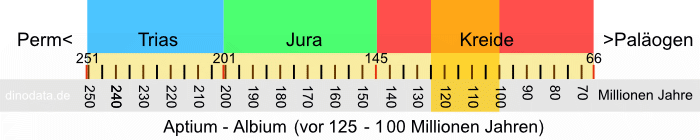
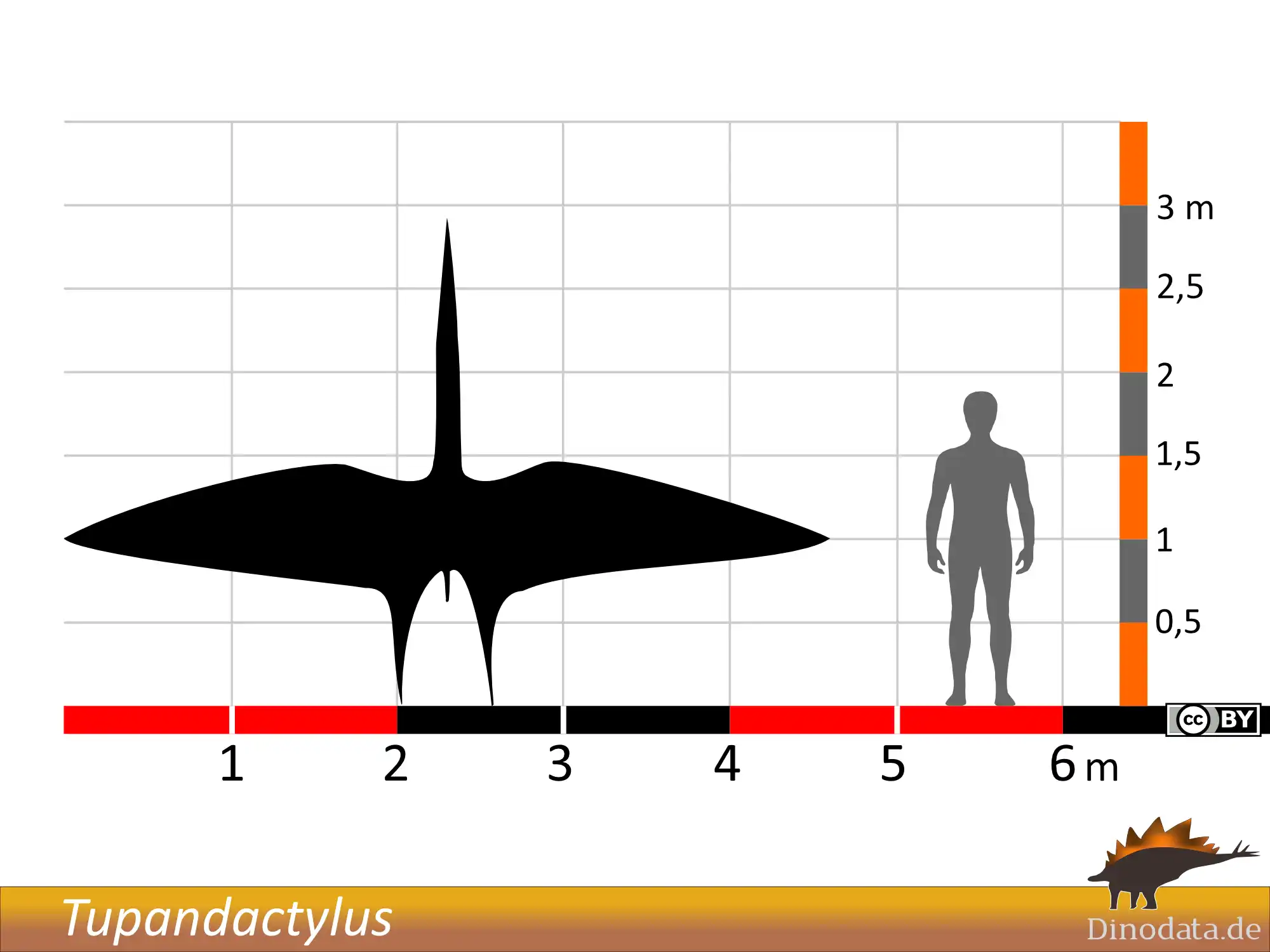
Tupandactylus war ein mittelgroßer Flugsaurier mit einer Spannweite von etwa 2,5 Metern aus der Familie der Tapejaridae, er lebte während der mittleren Kreidezeit vor etwa 113 Millionen Jahren im heutigen Südamerika. Die Beschreibung des Tupandactylus basiert auf einem fast vollständigen Schädel eines ausgewachsenen Exemplares, welches in der Crato Formation in Brasilien entdeckt wurde. Von seinen Entdeckern wurde Tupandactylus jedoch zunächst als Tapejara imperator beschrieben, bei späteren Forschungen stellte sich jedoch heraus, dass es sich um eine eigene Gattung handelte, welche dann den Namen Tupandactylus imperator erhielt.
Die Kiefer des Tupandactylus waren zahnlos, oben auf dem Schädel war ein Sagittalkamm und nur dessen Basis bestand aus knöchernen Material. Vorn auf dem Schnabel befand sich eine hoch nach oben ragende Knochenstange, die von einer breiten Basis spitz nach oben zulief und so ein Dreick bildete. Nach hinten über den Schädel hinaus verlief ein dünner Knochenstab. Zwischen beiden Stäben befand sich ein großes Hautsegel, welches durch dünne knöcherne Stäbe gestützt wurde.
Spannweite: 4,5 m
Gewicht: 10 kg
Holotyp: MCT 1622-R
Fundort: Santana Formation, Crato, Ceará, Brasilien
© Dinodata.de
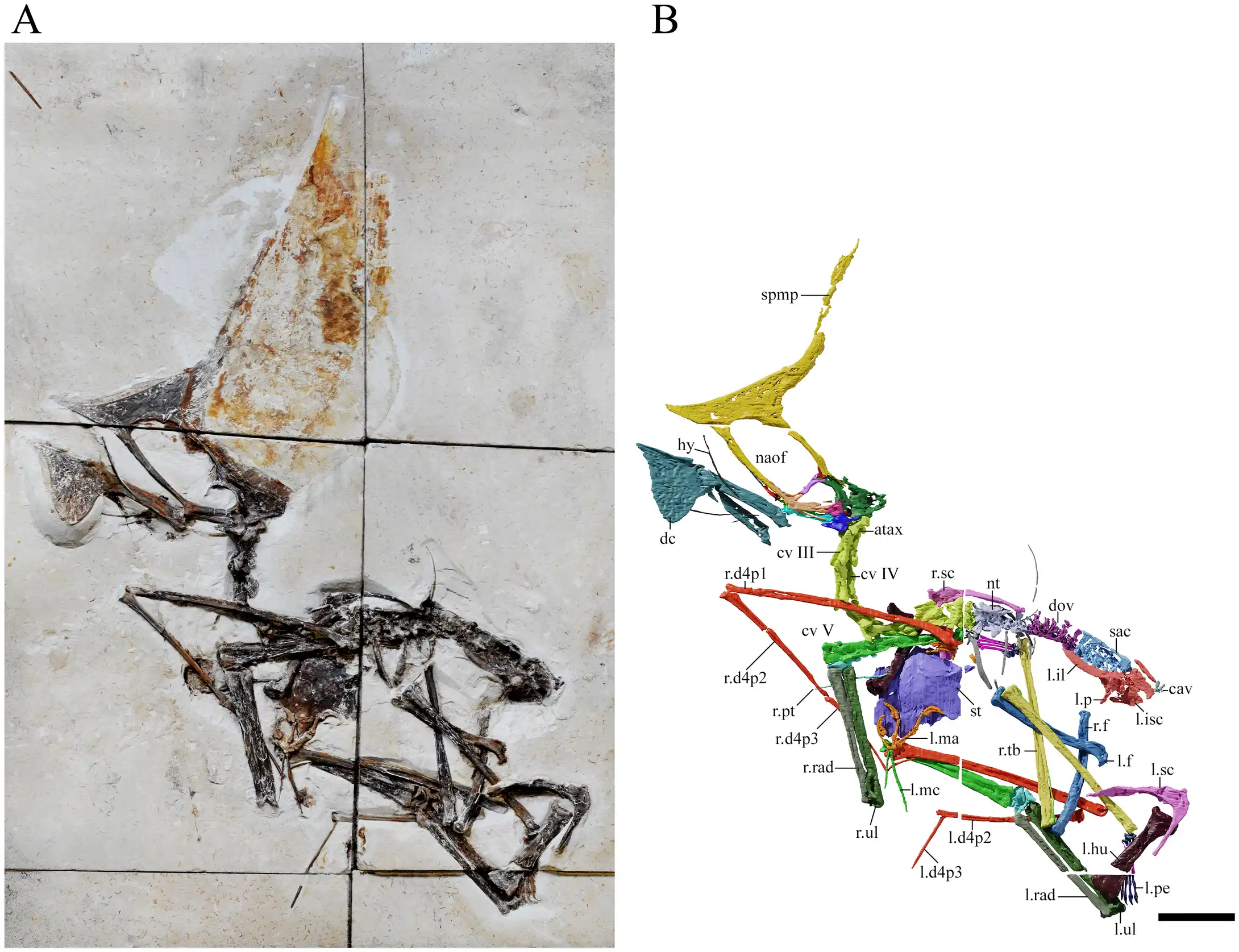
© Beccari et al.
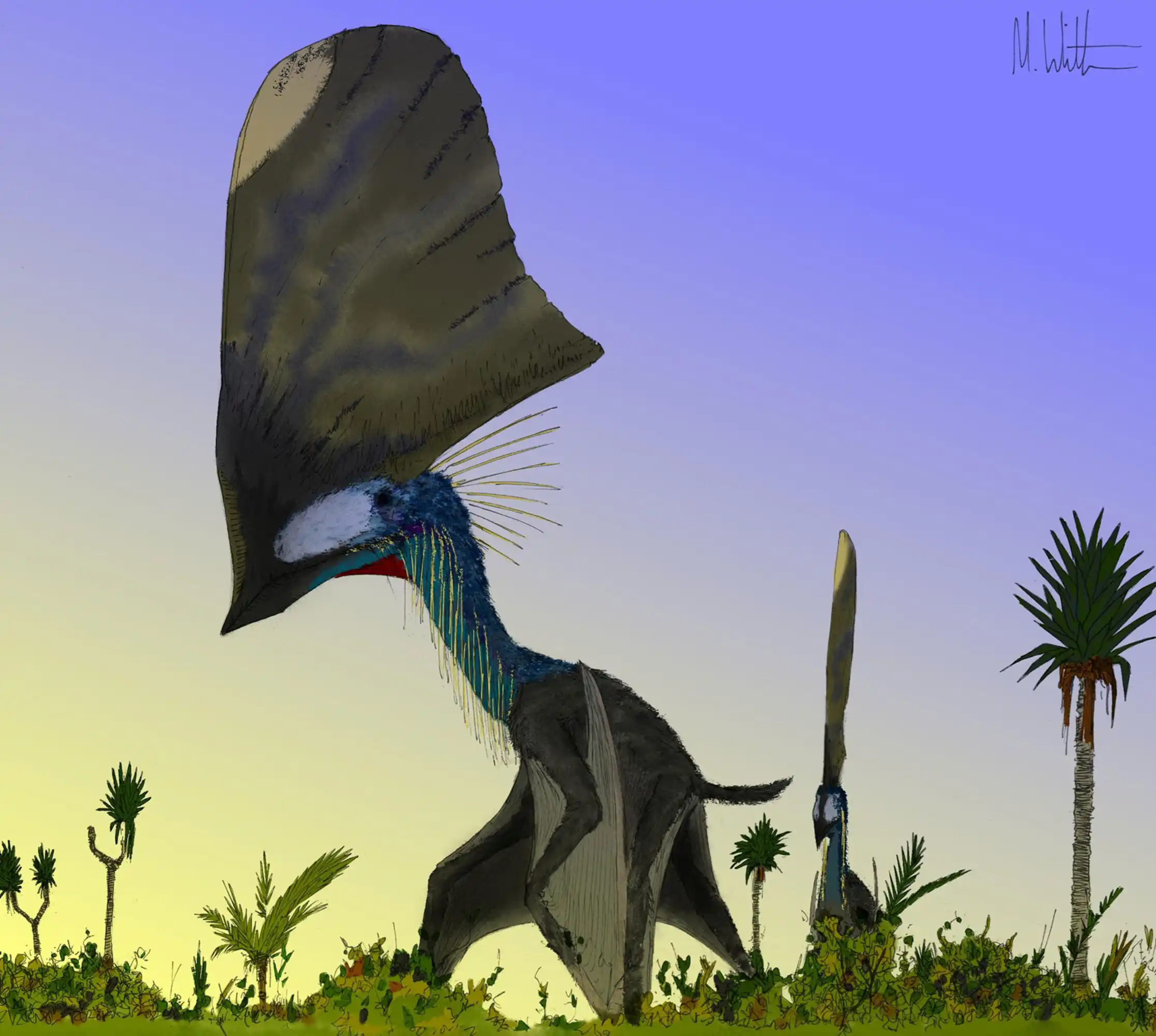
© Mark Witton
Weitere Informationen
Cretaceous Pterosaurs of the Araripe Basin: A Comprehensive Taxonomic Update and Paleobiological Insights / Pinheiro et al., 2025 / Anais da Academia Brasileira de Ciências, 97 (Suppl. 1) /  PDF
PDF
Description of two pterosaur (Pterodactyloidea) mandibles from the Lower Cretaceous Santana Formation, Brazil / André J. Veldmeijer, Marco Signore, Hanneke J. M. Meijer, 2005 / DEINSEA 11: 67-86; ISSN 0923-9308
Exploring the complex cranial morphology of Tupandactylus imperator (Pterodactyloidea, Tapejaridae) based on a new specimen / Lucas Canejo, Juliana M. Sayao, Alexander W. A. Kellner, 2025 / Anais da Academia Brasileira de Ciências, 97 (Suppl. 1) /PDF
New information on the pterosaur Tupandactylus imperator, with comments on the relationships of Tapejaridae / Felipe L. Pinheiro, Daniel C. Fortier, Cesar L. Schultz, José Artur F. G. De Andrade, Renan A. M. Bantim, 2011 / Acta Palaeontologica Polonica 56 (3), 2011: 567-580 /PDF
Osteology of an exceptionally well-preserved tapejarid skeleton from Brazil: Revealing the anatomy of a curious pterodactyloid clade / Victor Beccari, Felipe Lima Pinheiro, Ivan Nunes, Luiz Eduardo Anelli, Octávio Mateus, Fabiana Rodrigues Costa, 2021 / PLoS ONE 16(8): e0254789 / PDF
Pterosaur melanosomes support signalling functions for early feathers / Aude Cincotta, Michaël Nicolaï, Hebert Bruno Nascimento Campos, Maria McNamara, Liliana D’Alba, Matthew D. Shawkey, Edio-Ernst Kischlat, Johan Yans, Robert Carleer, François Escuillié, Pascal Godefroit, 2022 / Nature 604, 684–688 (2022) /PDF
Short note on the ingroup relationships of the Tapejaridae (Pterosauria, Pterodactyloidea) / Alexander W. A. Kellner, Diogenes de Almeida Campos, 2007 / Boletim do Museu Nacional. 75: 1–14
The Function of the Cranial Crest and Jaws of a Unique Pterosaur from the Early Cretaceous of Brazil / Alexander Wilhelm Armin Kellner, Diogenes de Almeida Campos, 2002 / Science 08/2002; 297(5580):389-92
- - - - -
Bildlizenzen
Größenvergleich / © Dinodata.de:
 Creative Commons 4.0 International (CC BY 4.0)
Fossil des Tupandactylus / © Beccari et al.:
Creative Commons 4.0 International (CC BY 4.0)
Tupandactylus / © Mark Witton:
 Creative Commons NonCommercial-ShareAlike 2.0 Generic (CC BY-NC-SA 2.0)